English
 Arabic
 Russian
 French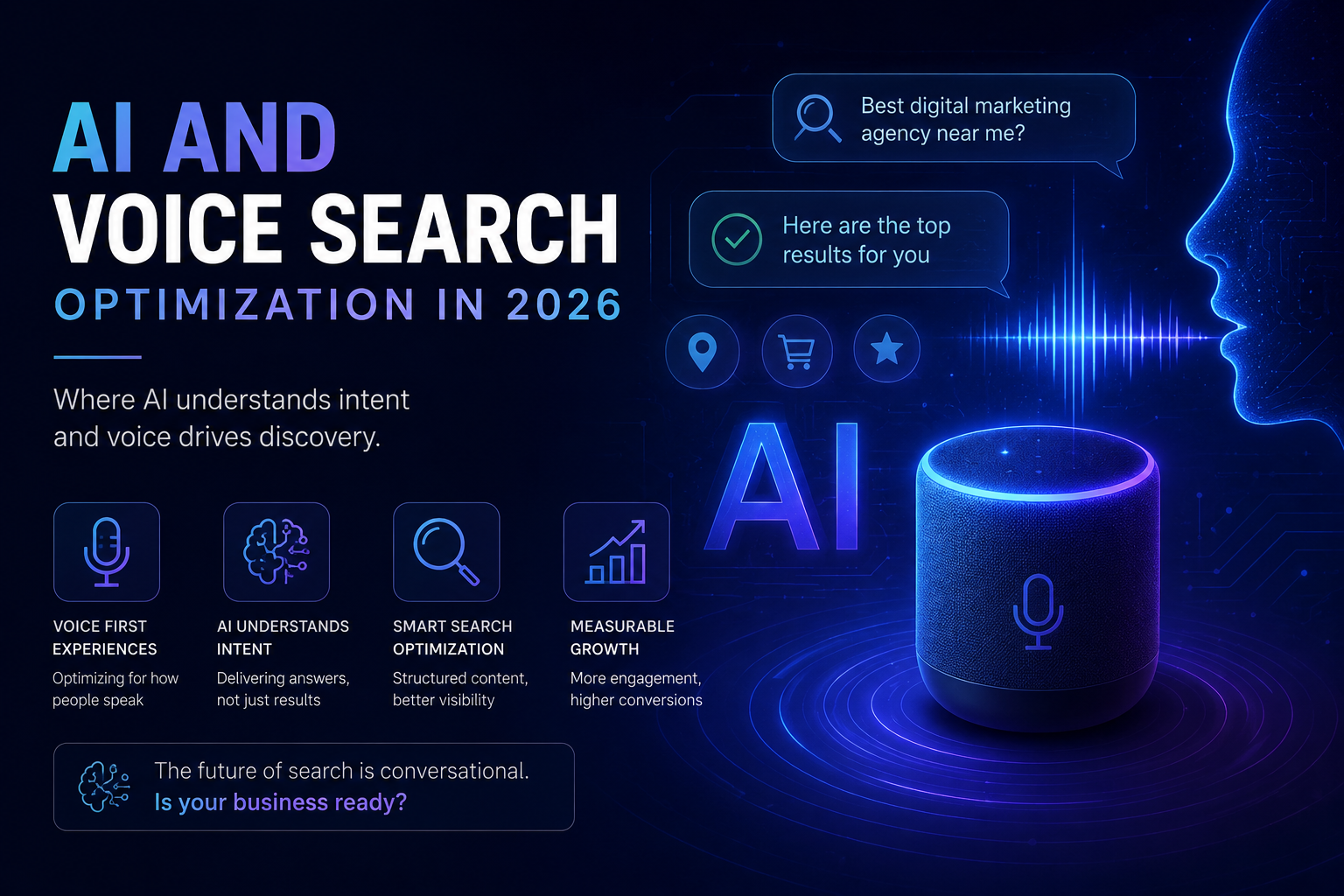
The way people search has changed. Quietly, persistently, and now - irreversibly.
In 2026, nearly half of all online searches in the GCC region are initiated through voice. Residents across Dubai, Abu Dhabi, Riyadh, and Doha are asking their smartphones, smart speakers, and AI assistants - not typing. They say "Hey Siri, find the best SEO agency near me" rather than keying in "SEO company Dubai." And that single shift in human behavior is rewriting the entire rulebook of digital marketing.
For businesses in the UAE and wider Middle East, this isn't a trend to watch. It's a transformation to act on - right now.
At Digital Arabia, we've been helping 400+ brands grow their digital presence across the region for over 11 years. And we can tell you with certainty: companies that align their SEO strategy with AI-powered voice search today will dominate tomorrow's search rankings. Those who don't will quietly disappear from them.
This blog breaks down exactly what voice search optimization looks like in 2026, why AI is at the center of it, and what practical steps UAE businesses must take to stay visible, relevant, and competitive.
Why Voice Search Is No Longer Optional
Voice search adoption in the Middle East has accelerated faster than anywhere else in the world - for three compelling reasons.
Multilingual convenience. The UAE is home to over 200 nationalities. Arabic, English, Hindi, Tagalog, Urdu - people naturally switch between languages in daily conversation. Voice search accommodates this fluency far more intuitively than typing, which has driven extraordinary adoption rates across the Emirates.
Smartphone-first culture. With some of the highest smartphone penetration rates globally, UAE consumers are deeply comfortable using voice features. Asking Siri, Google Assistant, or Alexa a question is as natural as sending a WhatsApp message.
AI assistants have become genuinely smart. The voice assistants of 2024 were impressive. The AI assistants of 2026 are transformative. They understand context, remember previous queries, interpret intent - not just keywords - and deliver precise, conversational answers. Users trust them. And they use them constantly.
The result: if your business isn't optimized for voice search in 2026, you're effectively invisible to a rapidly growing segment of your target audience.
How AI Has Transformed the Voice Search Ecosystem
Understanding voice search in 2026 requires understanding how AI has fundamentally changed what search engines are looking for - and rewarding.
From Keywords to Intent
Traditional SEO was built on keywords. You researched the exact phrases people typed, and you optimized your content to match those phrases. Voice search broke that model.
When someone speaks a query, they use full sentences, natural phrasing, and contextual language. "What's the best digital marketing agency in Dubai for a small e-commerce brand?" is very different from typing "digital marketing Dubai." AI-powered search engines - particularly Google's Search Generative Experience (SGE) and Bing's AI search - are now trained to interpret intent, not just match strings.
This means your content must answer questions, not just contain keywords. It must reflect how real people actually speak.
Featured Snippets and Position Zero
Voice assistants almost always pull their spoken answers from a single source: the featured snippet, or what SEO professionals call Position Zero. When Google's AI reads out an answer to a voice query, it typically reads one result - the one it deems most authoritative, most structured, and most directly responsive to the question asked.
Owning Position Zero in your niche is now one of the most valuable pieces of digital real estate available to a UAE business. It requires a deliberate content strategy built around question-and-answer formats, structured data, and clear, concise responses.
Conversational AI and Search Continuity
In 2026, AI assistants maintain conversational context across multiple queries. A user might ask "Which are the top areas to buy property in Dubai?" followed by "What about for investment returns specifically?" - and the assistant understands the second question refers to Dubai property without the user having to repeat the context.
For businesses, this means content needs to address follow-up questions and related topics within the same piece, not just isolated keywords. Depth, relevance, and topical authority matter more than ever.
The UAE Market: Specific Opportunities and Considerations
Voice search optimization in the UAE comes with its own unique landscape - one that most generic guides overlook entirely.
Arabic Voice Search Is Booming
Arabic is one of the fastest-growing languages in voice search globally. Google, Apple, and Amazon have all significantly improved their Arabic language AI in recent years, making voice search in Arabic dramatically more accurate and useful.
For businesses targeting Arabic-speaking audiences - whether Emirati nationals, Saudi visitors, or Arabic-speaking expats - optimizing content in Modern Standard Arabic (MSA) as well as relevant Arabic dialects is becoming essential. A bilingual voice search strategy is no longer a luxury; it's a competitive necessity.
Local Search Dominates Voice Queries
Studies consistently show that over 60% of voice searches have local intent. People use voice to find things near them, right now. Restaurants, clinics, real estate agencies, retail shops, service providers - the "near me" query is the backbone of voice search behavior.
For UAE businesses, this makes local SEO and voice search optimization inseparable. Your Google Business Profile must be impeccably maintained, your location data must be precise across all directories, and your content must incorporate hyper-local signals - neighborhood names, landmarks, metro stations, and community references that real Dubai or Abu Dhabi residents actually use.
Mobile and WhatsApp Integration
In the UAE, consumer behavior is deeply intertwined with WhatsApp and mobile-first browsing. AI assistants are increasingly integrated with messaging platforms, meaning that a voice search query might lead directly to a WhatsApp inquiry to a business. Ensuring your contact channels are seamlessly connected to your voice-optimized presence is an often-overlooked but critical step.
7 Voice Search Optimization Strategies That Work in 2026
Here is a practical, prioritized playbook for UAE businesses ready to take voice search seriously.
1. Build Content Around Conversational Questions
Stop writing for keywords. Start writing for questions. Use tools like Google's People Also Ask section, Answer The Public, and your own customer service data to identify the specific questions your target audience is asking.
Structure your content to answer these questions directly and concisely. A crisp, clear answer in the first 40-50 words of a section dramatically increases your chances of winning a featured snippet - and by extension, a voice search result.
Practical tip: Create an FAQ page that addresses your most common customer queries. Keep each answer under 60 words. Format it with proper schema markup. This is one of the most reliable paths to Position Zero.
2. Implement Structured Data (Schema Markup)
Schema markup is the language that tells search engine AI exactly what your content is about. In 2026, structured data is not optional for voice search success - it is foundational.
Use schema types relevant to your business:
- LocalBusiness schema - for all UAE-based businesses with a physical presence
- FAQPage schema - for your question-and-answer content
- Product schema - for e-commerce businesses
- Service schema - for agencies, consultancies, and professional services
Proper schema implementation dramatically increases the likelihood that AI-powered search engines select your content for voice responses.
3. Optimize Your Google Business Profile Obsessively
Your Google Business Profile (GBP) is your most powerful local voice search asset. In 2026, an incomplete or neglected GBP profile is a direct cause of lost voice search traffic.
Ensure your profile includes: accurate business name, address, and phone number; comprehensive business category selection; updated business hours (including Ramadan hours, if applicable); high-quality photos; regular Google Posts; and prompt responses to all reviews.
Voice assistants prioritize businesses with complete, well-maintained GBP profiles when answering "near me" and location-specific queries. This is non-negotiable for any UAE business with a local customer base.
4. Optimize for Long-Tail, Conversational Keywords
Voice queries are longer and more conversational than typed searches. Your keyword strategy needs to reflect this reality.
Instead of targeting "digital marketing agency Dubai," create content that also addresses "which digital marketing agency in Dubai is best for growing an e-commerce business?" or "how much does SEO cost in Dubai?"
Long-tail voice keywords have lower competition and higher conversion intent - users asking specific questions are far closer to making a purchasing decision than users typing broad terms.
5. Prioritize Page Speed and Mobile Performance
Voice searches happen predominantly on mobile devices, and AI search engines actively penalize slow, poorly optimized mobile experiences. In 2026, Google's Core Web Vitals remain a critical ranking factor - and they are weighted even more heavily in mobile and voice search contexts.
Your website should load in under 2.5 seconds on mobile. Pages should be clean, scannable, and free of intrusive pop-ups or elements that degrade the mobile reading experience. If your site feels sluggish on a smartphone in Jumeirah or Business Bay, it will not rank for voice searches originating from those locations.
6. Create Conversational, AI-Friendly Content
In the era of AI search, content quality has reached a new benchmark. Google's AI systems - Gemini-powered search in particular - evaluate content for expertise, experience, authoritativeness, and trustworthiness (E-E-A-T). Thin, generic, keyword-stuffed content is actively penalized.
Write with genuine expertise. Incorporate real data, local market insights, and specific examples relevant to your UAE audience. Long-form, comprehensive content that thoroughly addresses a topic not only builds authority - it gives AI systems more to extract and surface in voice responses.
7. Build a Bilingual Voice Search Strategy
If your business serves both Arabic and English speakers - and most UAE businesses do - your voice search optimization must operate in both languages simultaneously.
This goes beyond simple translation. Arabic content should be written natively, reflecting how Arabic speakers naturally phrase questions about your industry. It should incorporate Arabic local search terms, Arabic schema markup, and Arabic-language FAQ structures.
At Digital Arabia, our SEO team works natively in both Arabic and English - precisely because the UAE market demands a bilingual digital presence that is authentic in both languages, not merely translated.
The Connection Between AEO, GEO, and Voice Search
Two terms you will increasingly encounter in 2026's SEO conversation are Answer Engine Optimization (AEO) and Generative Engine Optimization (GEO) - and both are directly linked to voice search success.
AEO refers to optimizing your content to be selected by AI answer engines - whether that's Google's SGE, ChatGPT's browsing capability, Perplexity AI, or voice assistants. The goal is to be the source that AI cites when a user asks a question in your domain.
GEO refers to ensuring your brand and content appear prominently in AI-generated responses - the new form of organic visibility in an era where users increasingly receive summarized, AI-generated answers rather than a list of blue links.
Voice search sits at the intersection of both. When a user asks their AI assistant a question about your industry, you want your content to be the authoritative source that gets cited - spoken aloud to the user as the answer. That is the ultimate goal of voice search optimization in 2026.
Measuring Voice Search Success
Voice search performance is harder to measure than traditional SEO - but not impossible. Key metrics to track include:
Featured snippet rankings. Monitor which of your target queries surface a featured snippet, and whether you own it. Tools like SEMrush and Ahrefs provide featured snippet tracking.
Local search visibility. Track your Google Business Profile insights: how many users found you through direct vs. discovery searches, and how many triggered calls or direction requests - common outcomes of voice-initiated local searches.
Long-tail keyword traffic. Analyze organic search traffic for conversational, question-based keywords. Growth in this segment is a strong indicator of improving voice search visibility.
Zero-click traffic indicators. An increase in branded searches, direct traffic, and phone inquiries alongside stable or slightly declining click traffic may indicate that users are finding you through voice and acting directly - rather than clicking through to your website first.
How Digital Arabia Can Help
Voice search optimization is not a one-time project. It is an ongoing, evolving strategy that requires expertise across technical SEO, content creation, local optimization, and AI search dynamics - all applied with a deep understanding of the UAE and GCC market.
At Digital Arabia, our team has already begun implementing voice-first SEO strategies for clients across Dubai, Abu Dhabi, and the broader Middle East. From structured data implementation and Arabic content optimization to Google Business Profile management and AI-aligned content frameworks, we offer the end-to-end expertise your business needs to lead in voice search.
With over 11 years of experience, 500+ websites launched, and 40% average increase in organic traffic for our clients, we understand what it takes to build sustainable digital visibility in one of the world's most competitive markets.
The businesses that invest in voice search optimization today will be the ones that customers find - and trust - tomorrow.
Final Thoughts
AI and voice search are not separate trends layered on top of traditional digital marketing. They are the new foundation of how consumers discover, evaluate, and choose businesses in the UAE. The search bar is giving way to the spoken word. The keyword is giving way to the conversation.
For UAE businesses - whether you're in real estate, healthcare, e-commerce, education, or professional services - the question is not whether to optimize for voice search. The question is how quickly you can get ahead of your competitors who haven't started yet.
Start with your content. Start with your local presence. Start with the questions your customers are already asking.
Start with us today.
Digital Arabia is a leading digital marketing agency in Dubai, providing comprehensive SEO, SEM, social media marketing, website development, and content strategy services across the UAE and GCC region. Contact us today for a free SEO consultation.
Call +971 585819677 | Website: www.digitalarabia.ae | Mail at: info@digitalarabia.ae
702 - Aspin Commercial Tower, Sheikh Zayed Road, Dubai, UAE