English
 Arabic
 Russian
 French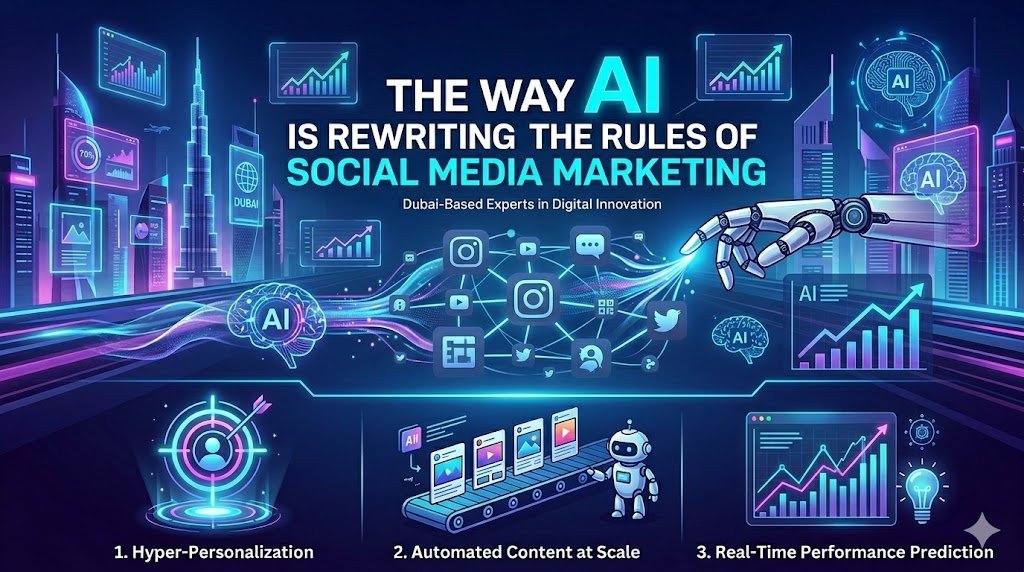
The artificial intelligence is not only aiding marketers in
the Gulf, but also in hyper-personalised content and real-time intelligence of
an audience. It is getting to be the strategy itself.
Social
media marketing was an exercise of creativity, intuition, and guesswork in
the not-so-distant past. Marketers were left to the devices of scheduled
content calendars, rudimentary analytics, and periodic campaign reviews to
figure out what worked. Often it was a matter of trial and error -post, wait,
analyze and adjust.
The model is fast becoming obsolete today.
AI has significantly changed the manner in which brands use
social media, particularly in vibrant markets such as Dubai and the MENA region
in general. AI has become not an up-sell support tool, but a fundamental
strategic engine that can make decisions, create content, and optimize
performance in real time.
It is not a mere change of direction. It is structural.
The emergence of AI-based marketing in
the MENA Region
Businesses are also adopting AI at a faster rate across the
Gulf. Marketers are using AI to optimize daily operations, not as an
experiment, but as a necessity, both in startups and enterprise brands.
Why? The results are too important to be overlooked.
AI allows brands to work through large volumes of audience
data in seconds, identify trends that would have eluded human workers, and
respond to them more quickly than ever. This is priceless in an area as
heterogeneous and culturally complex as MENA.
The campaign, which appeals to people in Jumeirah, might not
work in the same manner in Deira. There is a diversity in language preferences,
cultural context, and consumer behavior - and AI can make sense of it at a
massive scale.
The Content That Knows Your Audience
Creation of content is one of the strongest effects of AI.
Conventionally, marketers used to schedule content a week or
a month ahead according to assumptions or seasonal or previous performance.
However, the current audience is dynamic: their interests change fast, and the
old-fashioned planning is not always able to keep up.
AI changes that.
AI-based platforms today analyze real-time signals
including:
- Scroll
behavior
- Engagement
patterns
- Comment
sentiment
- Share
and save rates
This information is then returned to the content strategy
nearly in real time. Brands can adapt within hours, as opposed to weeks to
maximize.
The result? More relevant, more timely, and more
personalized content.
And customization is no longer a choice, it is a given.
Customers of the modern online world desire to be heard.
They interact with brands that are in their language, their culture and address
their needs. The level of personalization is scalable with AI.
Hyper-Personalisation at Scale
AI does not only enhance content, but also changes the way
audiences are segmented and targeted.
AI creates micro-segments, rather than the broad demographic
categories such as age or location, which rely on actual behavior. These
segments are much more specific and operational.
For example:
·
Consumers who consume luxury regularly.
·
The viewers that react to Ramadan
advertisements.
·
Customers that communicate in Arabic and not
English.
Every section can be delivered unique messages, innovative
formats, and posting times all with maximized engagement.
Such a level of granularity was almost unattainable
manually. When using AI, it is the rule.
Meaningful Uses of AI Are Where AI Is
Making the Biggest Impact.
AI is affecting all levels of the social media marketing
funnel. The most notable applications are:
1. Content Generation
Within minutes, AI applications can produce captions,
advertisement texts, hooks, and even visual concepts in Arabic and English.
Such outputs are not universal, but platform-specific sounds like Instagram,
Linked In, or Tik Tok.
This drastically saves time of production as well as quality
and consistency.
2. Audience Segmentation
AI recognizes trends in user behavior and develops highly
targeted groups of audiences. This gives the brands the ability to stop relying
on guesswork and produce messages that truly resonate.
3. Influencer Selection
The selection of an influencer is no longer determined by
the number of followers. AI determines authenticity, the quality of engagement,
and alignment with the audience to select influencers who are a perfect fit
with the brand.
4. Predictive Posting
Rather than depending on generalized best times to post, AI
suggests the best posting times depending on the audience behavior - platform
by platform, segment by segment.
Speed, Efficiency, and Competitive Advantage
The marketing environment in Dubai is highly competitive.
Brands are in a race to be heard in a digital world that is saturated.
Speed is important in this case.
AI can greatly decrease the time required to turn around the
campaign by automating repetitive tasks, increasing the speed of content
creation, and simplifying decision-making. What would have been done in weeks
now can be done in days, maybe even hours.
Speed is not the advantage, though.
The true benefit is precision at speed - the capacity to be
fast and make evidence-based decisions.
AI-wise brands are not only fast, they are intelligent,
flexible, and efficient.
The Human Element: It Remains Replaceable
Though it has all of these features, AI does not replace
human creativity, and it should not be treated as such.
The most effective marketing departments are those who
manage to balance human intuition and machine intelligence.
Humans bring:
·
Cultural understanding
·
Emotional intelligence
·
Strategic direction
·
Creative storytelling
AI brings:
·
Data processing
·
Speed
·
Pattern recognition
·
Continuous optimization
The outcome when this is put together is a strong hybrid
model with creativity being augmented, and not substituted.
This balance is important in markets such as the UAE where
the cultural nuance is a key component in communication.
Challenges and Considerations
Although the advantages of the AI are enormous, it also
brings about new challenges that brands have to negotiate.
Data Privacy
The more data is used, the more responsibility will be
exercised. The brands need to make sure that they are not violating privacy
laws and that they do not lose the trust of the consumers.
Over-Automation
Dependence on AI too much may result in robotic or generic
content. Authenticity is essential and requires human control.
Skill Gaps
The implementation of AI needs new skills and training.
Teams should be prepared to operate using these tools.
The Future of Social Media Marketing
The shift toward AI-driven marketing is not a trend — it’s a
long-term transformation.
As AI continues to evolve, we can expect:
·
Even deeper personalization
·
More advanced predictive analytics
·
Fully automated campaign optimization
·
Greater integration across marketing channels
In the near future, social media strategies will not just be
supported by AI — they will be built around it.
Final Thoughts
The question is no longer whether brands should adopt AI in
their social media strategy—this has already been decided. The real question is
how quickly they can adapt and implement it effectively. Brands that embrace AI
as a strategic partner, like Digital
Arabia, are gaining a significant competitive edge by delivering more
relevant content, engaging audiences more meaningfully, and achieving stronger
ROI. On the other hand, those that hesitate risk falling behind in an
increasingly data-driven landscape. AI is not just rewriting the rules of
social media marketing—it is redefining what success looks like, and
forward-thinking agencies like Digital Arabia are leading that transformation.